

RASTER: Reconfigurable Architecture for
Simulation Training, Engineering, and Rehearsal
RASTER: Reconfigurable Architecture for Simulation Training, Engineering, and Rehearsal
Training system architectures vary widely across mission platforms, device types, fidelity levels, and programs, and that variation drives significant cost into the concurrency, sustainment, and upgrade of every training system. ASI developed the Reconfigurable Architecture for Simulation Training, Engineering, and Rehearsal (RASTER) to solve that problem: a modern, open, modular, and non-proprietary architecture that brings commonality to disparate training systems and the individual devices within them, from small, lightweight Virtual, Mixed, or Augmented Reality devices to large operational and weapon systems trainers. For aircraft platforms, this means actual Operational Flight Programs are used with no or minimal modification, so cost savings are realized every time the aircraft Original Equipment Manufacturer releases a new version of the avionics.
From B-1 SBIR to a Reconfigurable Architecture
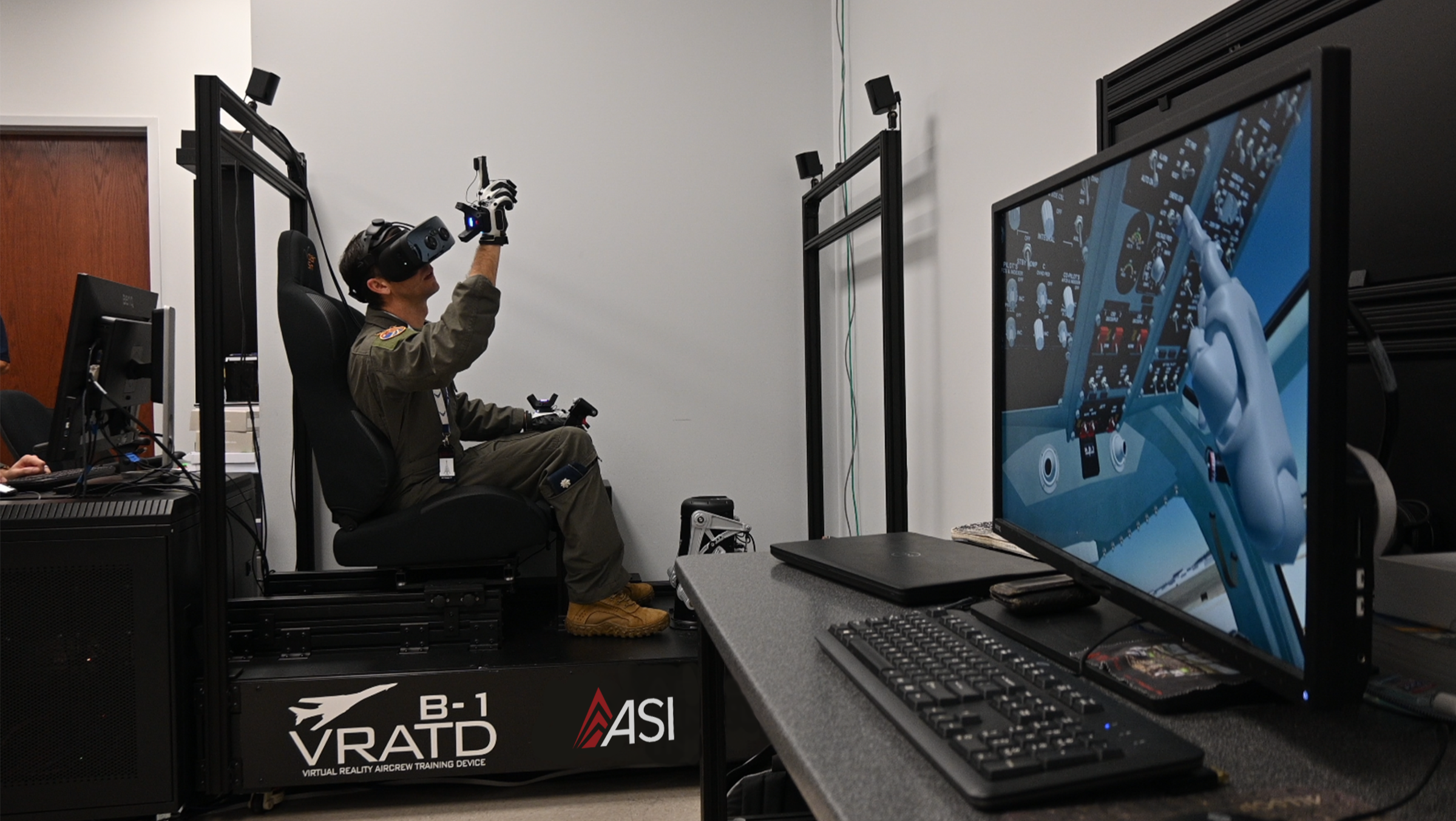
RASTER's development began as a Small Business Innovation Research (SBIR) direct-to-Phase-II contract to develop a Virtual Reality Aircrew Training Device (VRATD) for the B-1B Lancer, built around five objectives: containerizing aircraft Operational Flight Programs to run on Commercial-Off-The-Shelf servers; integrating those programs into a gaming engine environment with high-fidelity simulation software and modeling for accurate mission systems and platform performance; minimizing hardware footprint while maximizing COTS hardware and open standards; developing a modular, open, standards-based architecture extensible to other applications and to Live Virtual Constructive (LVC) Distributed Mission Operations (DMO); and providing a cybersecure, Risk Management Framework-compliant architecture. Once the VRATD was built, ASI extended the same architecture to the rest of the legacy B-1 Training System — Weapon Systems Trainers, Mission Trainers, Cockpit Procedures Trainers, and Maintenance Trainers will all be updated to the new architecture, making them common with each other and with the aircraft on an open, modular, small-footprint, COTS hardware design. Future software upgrades then only need to be made once, and they apply across every device in the system; aircraft common equipment (ACE) with its obsolescence and high repair costs is no longer needed to run real avionics.
What RASTER Delivers
Because aircraft avionics can be used throughout the training system, there's no longer a need to recode simulated avionics, which makes keeping training systems concurrent easier and cheaper than ever. RASTER also lets customers train to the mission on any device, from low-cost Virtual Reality trainers through full Weapon Systems Trainers, since every device runs the same high-fidelity software and avionics with full mission capability, and each device can connect to an LVC DMO network and interface with other devices and environment generators, such as the Next Generation Threat System (NGTS), to practice full crew coordination and large-force mission scenarios. RASTER also addresses obsolescence and diminished manufacturing sources: aircraft avionics often run on proprietary single board computers that are expensive and difficult to repair or replace, and RASTER allows customers to implement aircraft common software in a COTS computing environment running current, commercial operating systems, reducing or eliminating obsolescence issues for many applications.
Overall, RASTER delivers platform commonality to ensure concurrency and fidelity, low concurrency and sustainment costs, high-fidelity simulation across devices, training for all mission sets on every device, reconfigurability between mission system software versions, applicability across all domains — Sub-surface, Sea, Land, Air, Space, and Cyberspace — reduced obsolescence risk, common cybersecurity requirements and implementations, and reduced effort obtaining Authorizations to Operate and Authorizations to Connect.
A Simple Path to Adoption
RASTER is a SBIR Phase III eligible program, meaning any effort that derives or extends from its five core objectives can be sole-source directed to ASI, with no dollar limits and no time limits. Since our founding in 1983, ASI has been a high-tech, innovative company that can solve any training challenge, and RASTER is the newest tool ensuring warfighters get the training they need in revolutionary training systems.